Sprinkler repair cost in 2026 depends on the failed component, the work needed to reach it, and the testing required to confirm the repair; get a site-specific quote before approving the job. A quote for replacing a visible sprinkler head does not describe the full scope of tracing an underground leak or diagnosing a valve that will not close.
- Compare sprinkler repair cost by diagnosis, access, parts, labor, and final testing—not the total alone.
- A broken sprinkler head and an underground irrigation leak require different repair scopes.
- Lumiflowca provides irrigation repairs and installations for residential homeowners in Southern California.
- Request a written scope that distinguishes the immediate repair from recommended system improvements.
Why this matters
The useful number is the quote for your actual problem, not a general repair estimate. A dry patch, puddle, or weak spray tells you where to start looking. It does not establish which part has failed.
For homeowners in Riverside and Lake Elsinore, Lumiflowca offers irrigation repair and installation services. When requesting a quote, describe what happens before, during, and after watering so the conversation starts with the fault rather than an assumed replacement.
A useful sprinkler repair quote in 2026 connects the diagnosis to the work. You should understand what will be repaired, what access is required, and how the contractor will check that the problem is resolved.
How much does sprinkler repair cost in 2026?
Sprinkler repair cost is specific to the repair scope. Compare written quotes for the same work: diagnosis, access, replacement parts, labor, surface restoration, and operational testing.
A total without a scope leaves important questions unanswered. For example, replacing a damaged head and repairing the connection beneath that head are different jobs, even when the visible symptom looks similar.
What belongs in the cost breakdown?
| Quote component | What it covers | What to clarify |
|---|---|---|
| Diagnosis | Identifying the source of the irrigation problem | Is troubleshooting included or listed separately? |
| Access | Reaching the failed head, valve, fitting, or pipe | Does the work require excavation or access beneath a finished surface? |
| Parts | Components specified for the repair | Which parts are being replaced, and why? |
| Labor | Removing failed components and completing the repair | What work is included in the stated scope? |
| Restoration | Addressing areas disturbed during access | Who handles soil, planting, or hardscape restoration? |
| Testing | Checking operation after the repair | Will the affected zone be run and checked for leaks and coverage? |
Ask what happens if the diagnosis changes after excavation. Agree on how additional work will be explained and approved before the contractor proceeds beyond the original scope.
Do not assume every quote handles these items the same way. A clearly separated breakdown lets you compare the work without mistaking an incomplete scope for a better offer.
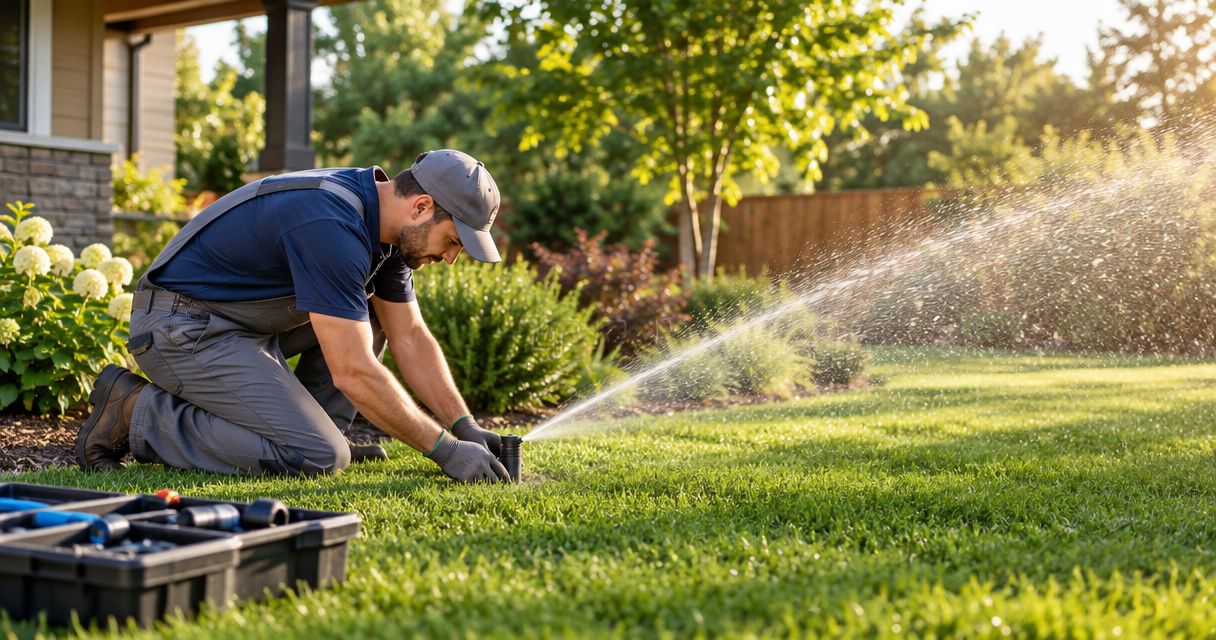
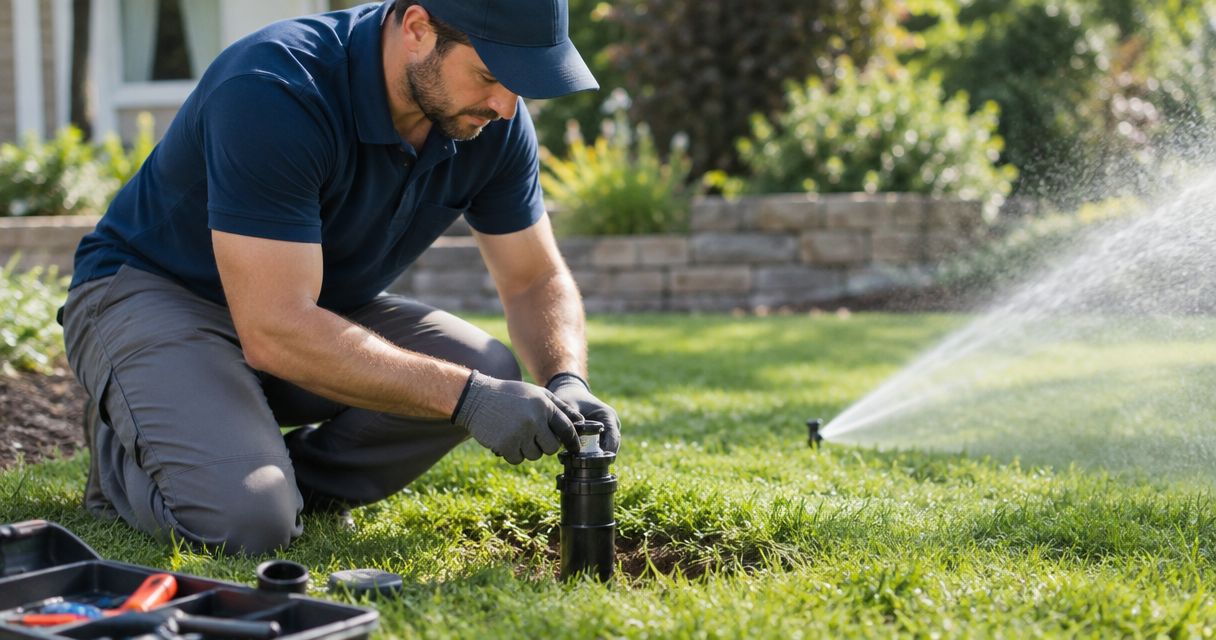
Head and nozzle repairs: confirm the connection underneath
A visibly damaged sprinkler head gives you a clear starting point. Water escaping beside the head, however, also calls for checking the connection below it rather than replacing the visible part alone.
Safe observations include looking for a cracked body, a tilted head, an obstructed spray pattern, or water collecting around the base while the zone operates. Avoid digging around a pressurized line or forcing a stuck assembly.
Ask whether the proposed repair includes checking the head's position and spray direction. A replacement that waters pavement or misses the intended planting area leaves a coverage problem even when the leak is gone.
The advantage of a localized head repair is its narrow scope when the fault is confirmed. The limitation is equally important: replacing a head does not correct an upstream pressure problem or a leaking buried connection.
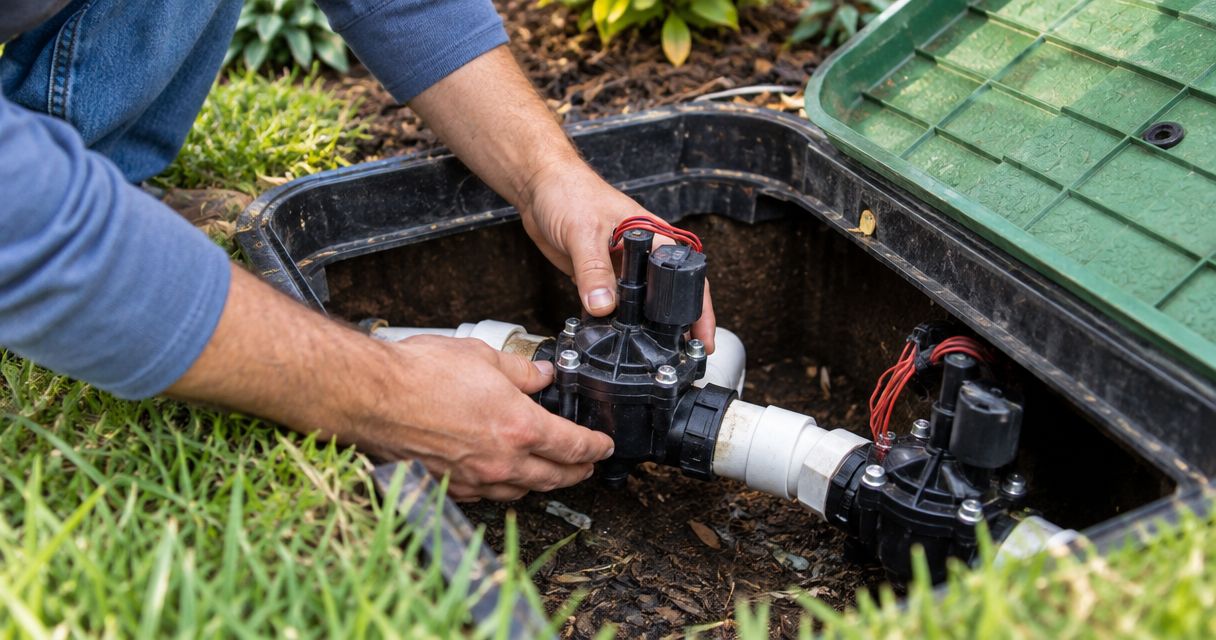
Valve repairs: distinguish a control problem from a water problem
A zone that does not start needs a different investigation from a zone that does not stop. Controller settings, wiring, valve operation, and the water supply all belong in that diagnosis; the symptom alone does not identify the failed component.
You can safely note which zone is affected and whether the controller displays a scheduled watering cycle. Record whether water continues flowing after that cycle ends, but leave electrical testing and valve disassembly to a qualified professional.
Ask the contractor to explain why repair or replacement is recommended. A valve replacement addresses a failed valve, not an unrelated controller setting or wiring fault.
The benefit of targeted valve work is correcting the identified control point. Its limitation is that the contractor still needs to verify the rest of the affected zone after restoring operation.
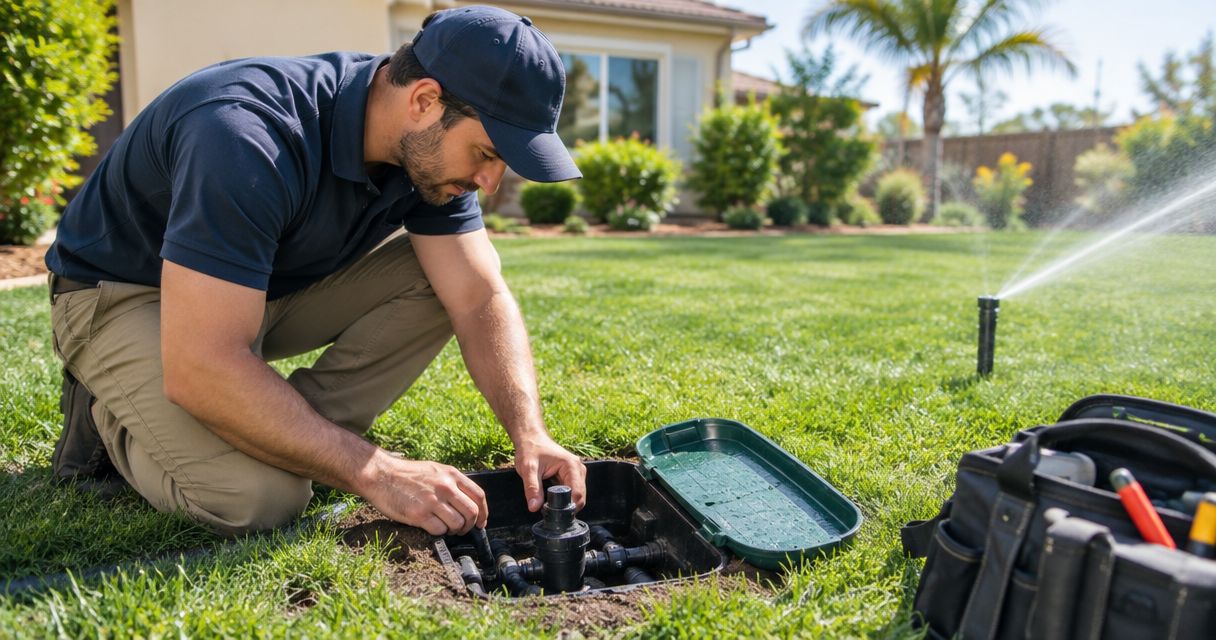
Underground leak repairs: access is part of the job
A wet area that remains after watering stops deserves investigation. The visible puddle does not establish the exact break location, particularly when water moves through soil before reaching the surface.
Describe where the wet area appears and whether it changes when a particular zone runs. Photographs taken from a safe location help you show the symptom without disturbing the site.
For a buried repair, ask what excavation and restoration the quote includes. A pipe beneath lawn, planting, or paving presents different access requirements, so surface conditions belong in the scope before work begins.
The benefit of repairing a confirmed pipe break is addressing the leak directly. The limitation is that opening the area can reveal additional damaged connections that need a separate explanation and approval.
Repair or replace: compare the scope before deciding
Repair the confirmed fault; consider broader replacement only when the diagnosis supports it. A single damaged component does not establish that the entire irrigation system needs replacement.
These service options address different problems. Use the comparison to ask better questions, not to choose a treatment before the system has been checked.
| Service option | Best for | Main benefit | Main limitation |
|---|---|---|---|
| Localized component repair | An isolated, confirmed head, fitting, or valve fault | Keeps the work focused on the identified failure | Does not address unrelated coverage or control problems |
| Buried pipe repair | A confirmed underground leak | Repairs the damaged section | Requires access and a clear restoration scope |
| Zone correction | Problems involving coverage or several components within one zone | Addresses the affected zone as a working unit | Requires diagnosis beyond the most visible symptom |
| System replacement | A documented need for broader redesign or replacement | Allows the layout and controls to be reconsidered together | Involves a wider construction scope than a localized repair |
A replacement recommendation should explain what repair would leave unresolved. Ask the same question of a limited repair: what problems, if any, will remain after this work?
Why sprinkler repair cost varies
The factors below change the amount and type of work. Your 2026 quote should tie each relevant factor to an observed condition rather than include unexplained additions.
- Fault location: A visible head problem and a buried pipe break require different access and repair work.
- Diagnostic scope: A clearly damaged component differs from an intermittent problem that requires checking controls, wiring, and water flow.
- Surface access: Lawn, planted beds, and hardscape create different excavation and restoration requirements.
- Affected components: The scope changes when the problem involves a connection, valve, pipe, or several interacting parts.
- Repair compatibility: Replacement components must suit the existing system and the intended watering area.
- Final verification: Leak checks, valve operation, spray adjustment, and coverage checks need a defined place in the job.
Separate necessary repairs from optional improvements. A controller change or coverage adjustment can be discussed alongside a repair, but you should know whether it fixes the reported fault or serves a different purpose.
What should happen before you approve a sprinkler repair?
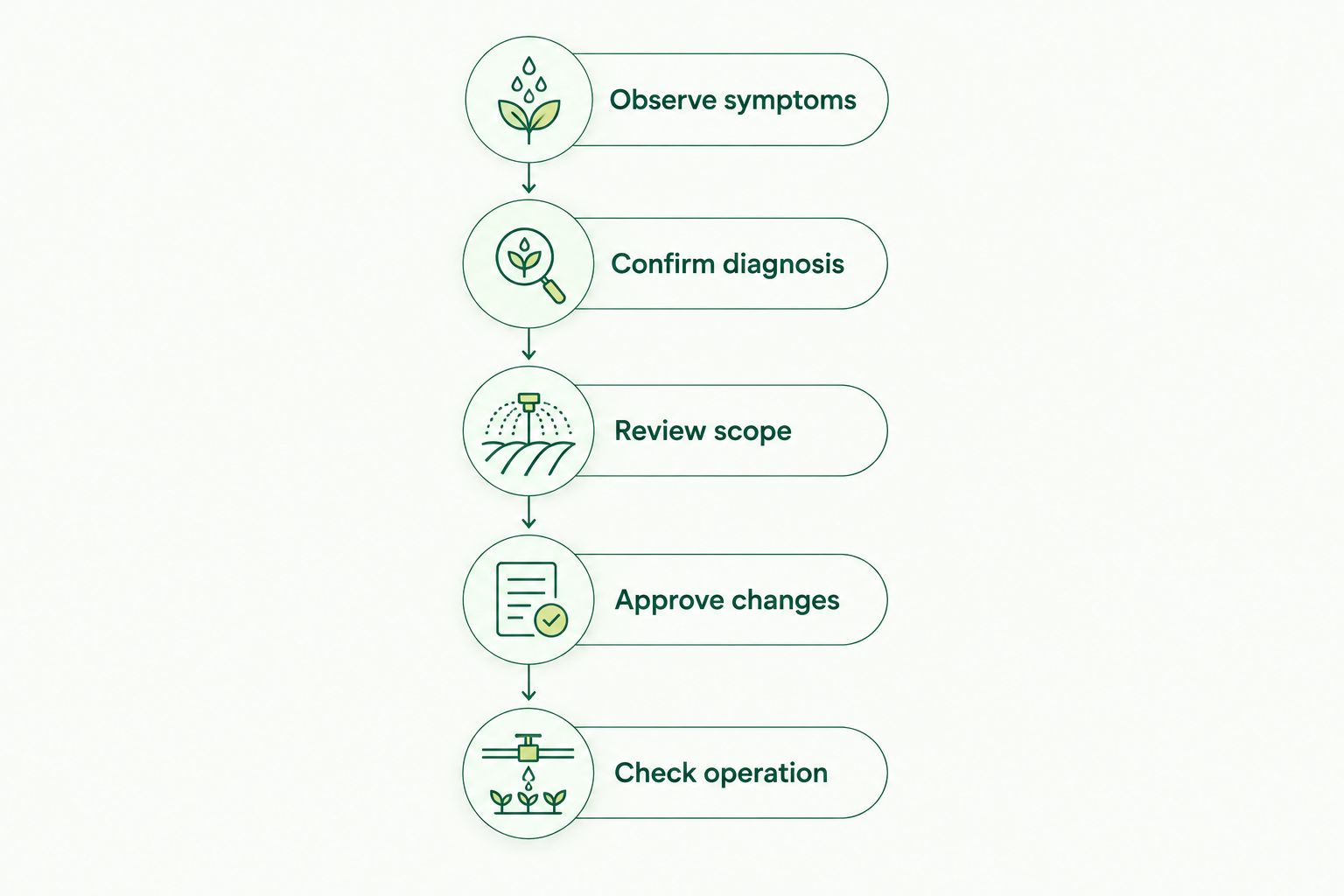
A clear repair process moves from observation to diagnosis, then approval and testing. Do not authorize a broad replacement simply because the first symptom is easy to see.
- Observe symptoms. Note the affected area, the zone involved, and when the problem appears. Take photographs without opening equipment or disturbing buried lines.
- Confirm diagnosis. Ask the contractor to identify the failed component and explain how it relates to what you observed.
- Review scope. Check the proposed parts, access work, restoration responsibilities, and testing. Separate required work from optional changes.
- Approve changes. Establish how the contractor will handle additional damage discovered during the repair. Require an explanation before expanding the job.
- Check operation. Have the affected zone run after the repair. Confirm that the original symptom is addressed and that any remaining issue is identified.
This sequence protects you from comparing unlike jobs. It also gives the contractor a clear approval point if the actual conditions differ from the initial diagnosis.
Keep the written scope and any approved changes together. They give you a useful reference when reviewing the completed work or explaining the repair during a later service visit.
What can you safely check before calling?
You can observe the system without taking it apart. Look at the controller's displayed schedule, identify the affected zone, and note obvious spray obstruction or visible damage from a safe position.
Do not touch exposed wiring, open equipment connected to household electrical power, or disassemble a pressurized valve. Excavation near unknown utilities and diagnosis of electrical faults belong with qualified professionals.
If water is actively escaping, stop the scheduled cycle using the controller's normal controls when safe. If flow continues, contact an irrigation professional rather than repeatedly running the system to investigate.
Your observations should help explain the symptom, not become a substitute for diagnosis. Tell the contractor what you saw and let the testing establish the cause.
Is sprinkler repair cheaper than replacing the system?
Sprinkler repair and system replacement are different scopes, so compare them only after the fault is identified. A localized repair addresses a specific failure; replacement involves broader work that needs its own justification.
Ask for the reason behind any replacement recommendation and what a repair would leave unresolved. A 2026 decision should follow the condition of your system, not an assumed age limit or a blanket recommendation.
Does a wet patch mean I have a broken sprinkler pipe?
A wet patch is evidence of unwanted water, not proof of a broken pipe. Note whether it appears during watering, remains afterward, or occurs when the system has not run.
Have the source confirmed before authorizing excavation. The useful repair is the one directed at the cause, not simply the location where water becomes visible.
How do I request a useful irrigation repair quote?
Describe the symptom, location, and timing, then ask for diagnosis and a written repair scope. Include any known recent repairs or changes to the planting area without assuming they caused the fault.
Lumiflowca is a fit for Southern California homeowners seeking irrigation installation and licensed landscape construction. For an irrigation repair request in Riverside or Lake Elsinore, ask for a plain-language explanation of the problem and the proposed work before approval.
Have your photographs and zone notes ready when you contact the service provider. They support the initial conversation; they do not replace an on-site assessment.
Request an irrigation repair quote
Describe your sprinkler problem and ask Lumiflowca about diagnosis and repair scope.
FAQ
How do I find out my sprinkler repair cost in 2026?
Get a site-specific quote based on diagnosis, access, parts, labor, restoration, and testing. Ask what requires separate approval if the contractor finds additional damage.
Can I get a sprinkler repair quote from a photo?
A photo helps describe a visible symptom, but it does not establish the full repair scope. Buried connections, valve faults, and electrical problems require further diagnosis.
Does replacing a sprinkler head fix low pressure?
Replacing a sprinkler head does not establish or resolve the cause of low pressure elsewhere in the system. Ask the contractor to confirm whether the head itself is faulty before approving replacement.
Should I repair one sprinkler or replace the whole system?
Repair an isolated fault when the diagnosis supports a localized repair. Consider broader replacement only when the contractor explains the system problems that a limited repair would leave unresolved.
What should an irrigation repair quote include?
An irrigation repair quote should identify the problem, proposed work, parts, access requirements, restoration responsibilities, and final testing. It should also distinguish necessary repairs from optional improvements.
Does Lumiflowca provide irrigation services for homeowners?
Lumiflowca provides residential irrigation repair and installation services in Southern California. Homeowners in Riverside and Lake Elsinore can request a quote and discuss the symptoms affecting their system.
One last thing
A sprinkler that turns on is not, by itself, proof of a completed repair. Ask to see the affected zone operate and confirm that the original leak, shutoff problem, or coverage issue has been addressed.
Before signing off on a 2026 repair, ask what was replaced and whether anything remains unresolved. That final explanation is more useful than leaving with a working controller but no understanding of the repair.